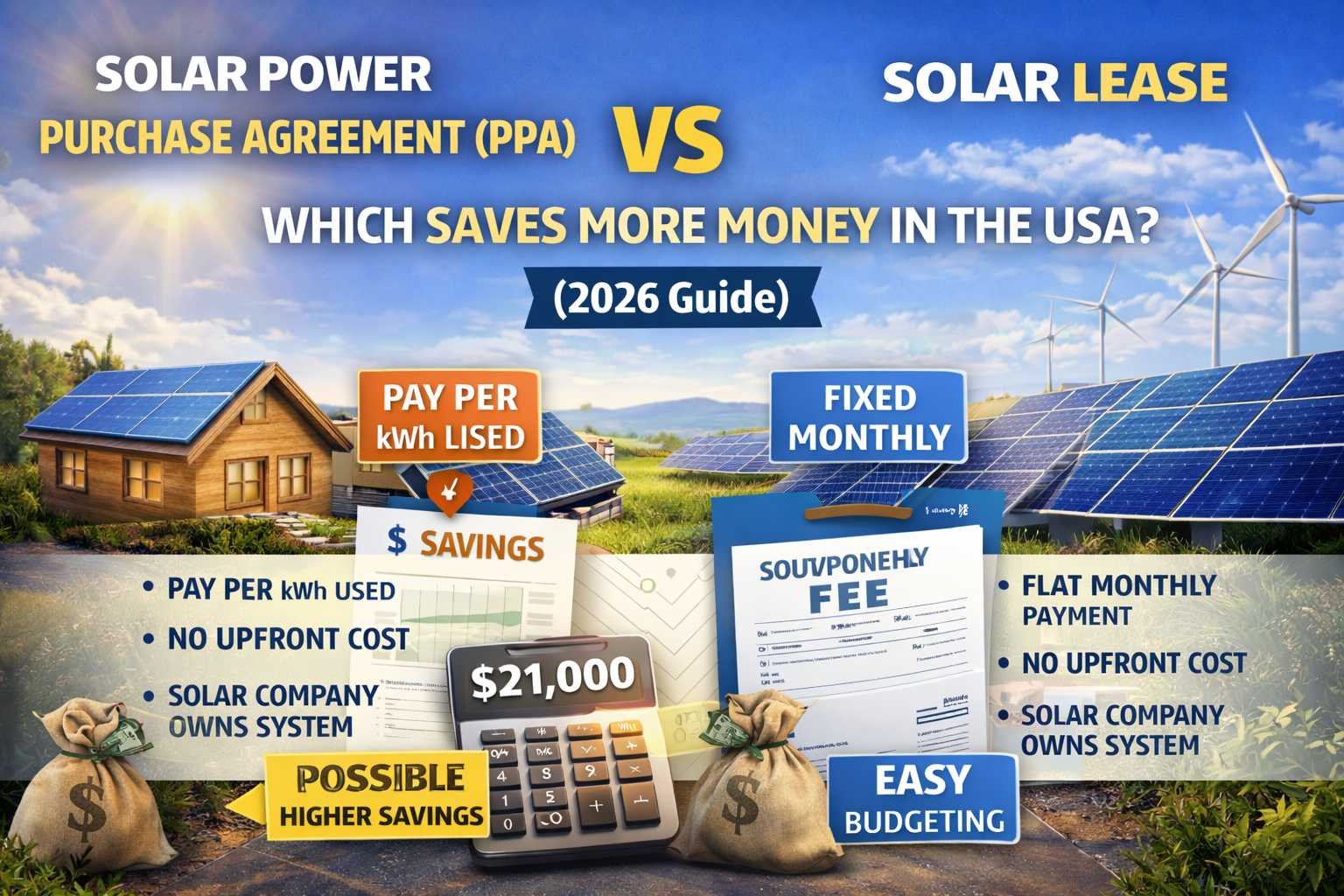
As solar energy becomes more popular across the United States, many homeowners are looking for ways to install solar panels without paying the full upfront cost. Two common options that allow homeowners to go solar with little or no upfront investment are Solar Power Purchase Agreements (PPAs) and Solar Leases.
Both options allow a solar company to install panels on your roof while you pay for the electricity or system usage over time. However, there are important differences between these financing models that affect monthly payments, long-term savings, and overall value.
In this guide, we will compare Solar PPA vs Solar Lease, explain how each works, and help homeowners understand which option may save more money in 2026.
What Is a Solar Power Purchase Agreement (PPA)?
A Solar Power Purchase Agreement (PPA) is a financing arrangement where a solar company installs solar panels on your property at little or no upfront cost. Instead of buying the solar system, the homeowner agrees to purchase the electricity generated by the solar panels at a fixed rate.
This rate is typically lower than the local utility company’s electricity price, which allows homeowners to reduce their monthly electricity bills.
Key Features of Solar PPAs
No upfront installation cost
The solar company owns and maintains the system
Homeowners pay only for the electricity produced
Electricity rate is usually lower than the utility rate
Long-term contract typically lasts 20–25 years
Solar PPAs are popular in states where electricity prices are high, such as California and New York.
What Is a Solar Lease?
A solar lease is another financing option where the solar company installs solar panels on your roof and retains ownership of the equipment.
Instead of paying for the electricity produced, the homeowner pays a fixed monthly fee to rent the solar system.
The monthly lease payment is typically predictable and does not depend on how much electricity the system generates.
Key Features of Solar Leases
Little or no upfront cost
Fixed monthly payment
Solar company owns and maintains the system
Contract terms usually last 20–25 years
Maintenance and repairs are included
Solar leases provide stable monthly payments, which some homeowners prefer for budgeting.
Key Differences Between Solar PPA and Solar Lease
Although both financing models allow homeowners to install solar panels without purchasing the system, the payment structure is different.
With a Solar PPA, homeowners pay for the electricity produced by the solar system.
With a Solar Lease, homeowners pay a fixed monthly fee regardless of electricity production.
This difference can influence the amount of money homeowners save over time.
Payment Structure
Solar PPA
Payment depends on how much electricity the system generates.
Solar Lease
Payment is fixed each month.
Savings Potential
Solar PPAs can sometimes offer higher savings when solar production is strong because homeowners pay only for the electricity generated.
Solar leases provide predictable payments but may offer slightly lower long-term savings.
Ownership
In both PPAs and leases, the solar company owns the solar system, not the homeowner.
Because of this, homeowners typically cannot claim the federal solar tax credit.
Average Savings with Solar PPA vs Solar Lease
Savings vary depending on electricity rates, solar production, and contract terms.
However, general estimates suggest:
Solar PPA savings: 10% to 30% reduction in electricity costs
Solar lease savings: 10% to 25% reduction in electricity costs
The exact savings depend on local utility prices and system performance.
Advantages of Solar Power Purchase Agreements
Solar PPAs have become popular because they align payments directly with energy production.
Benefits include:
Lower electricity rates compared to utilities
No system maintenance responsibilities
Potential for higher savings in sunny regions
No upfront installation costs
Homeowners only pay for electricity generated by the solar system.
Advantages of Solar Leases
Solar leases provide predictable monthly payments and simple contracts.
Benefits include:
Stable monthly payment
Minimal financial risk
Maintenance included
Easy budgeting for homeowners
Solar leases can be appealing for homeowners who prefer consistent monthly costs.
Disadvantages of Solar PPAs and Solar Leases
Although both financing options reduce upfront costs, they also have limitations.
Common disadvantages include:
Homeowners do not own the solar system
Federal tax credits usually go to the solar company
Long-term contracts (often 20–25 years)
Home sale complications if the contract must be transferred
Because the solar company owns the system, long-term financial savings may be lower than if the homeowner purchased the system outright.
Solar Loan vs Lease vs PPA
Many solar experts suggest comparing all three financing options before deciding.
Solar loans allow homeowners to own the solar system, which means they can claim the federal solar tax credit and receive the maximum long-term savings.
However, loans require credit approval and monthly payments.
PPAs and leases provide easier entry into solar energy but may offer lower lifetime savings.
Which Option Saves More Money?
In many cases:
Solar loans provide the highest long-term financial return.
Between Solar PPA vs Solar Lease, PPAs may offer slightly higher savings because payments are tied directly to electricity production.
However, the best option depends on the homeowner’s financial goals, electricity usage, and credit eligibility.
Is Solar Still Worth It in 2026?
Solar energy remains one of the most valuable home upgrades available in the United States.
With rising electricity prices and strong federal incentives, solar panels can significantly reduce long-term energy costs.
Whether homeowners choose a solar loan, solar lease, or power purchase agreement, switching to solar energy can provide meaningful savings and environmental benefits.
Final Thoughts
Solar Power Purchase Agreements and solar leases both provide ways for homeowners to install solar panels without a large upfront investment.
Solar PPAs allow homeowners to pay for the electricity produced by the system, while solar leases charge a fixed monthly payment for system use.
By understanding the differences between these options, homeowners can choose the financing model that best fits their budget and long-term financial goals.
As solar technology continues to improve and financing options expand, more households across the United States are adopting solar energy as a reliable and cost-effective power solution.