Installing solar panels is one of the most powerful ways homeowners in the United States can reduce long-term electricity costs. However, before installing solar, many homeowners ask an important financial question:
How much money will solar panels actually save over 25 years?
This is where a Solar Return on Investment (ROI) Calculator becomes useful. By estimating installation cost, electricity savings, and incentives, homeowners can determine the total financial return from a solar system.
In this guide, we’ll explain how solar ROI works and how to estimate the long-term savings of installing solar panels in the United States.
What Is Solar ROI?
Solar ROI (Return on Investment) measures the total financial return homeowners receive from installing solar panels compared to the initial installation cost.
Solar ROI includes several financial factors:
• Upfront installation cost
• Federal solar tax credit
• State incentives and rebates
• Electricity bill savings
• Rising electricity prices
• Solar system lifespan
Because most solar systems last 25 to 30 years, homeowners can generate electricity and savings for decades.
Average Cost of Solar Panels in the USA
The average residential solar installation in the United States costs between $18,000 and $30,000 depending on system size and location.
Typical solar system costs include:
5 kW system
Average cost: $15,000
7 kW system
Average cost: $21,000
10 kW system
Average cost: $30,000
However, the 30% Federal Solar Tax Credit significantly reduces the effective cost of installing solar panels.
Solar Cost After Federal Tax Credit
The federal solar incentive allows homeowners to deduct 30% of the installation cost from federal taxes.
Example:
Solar installation cost: $21,000
Federal tax credit (30%): $6,300
Net cost after tax credit:
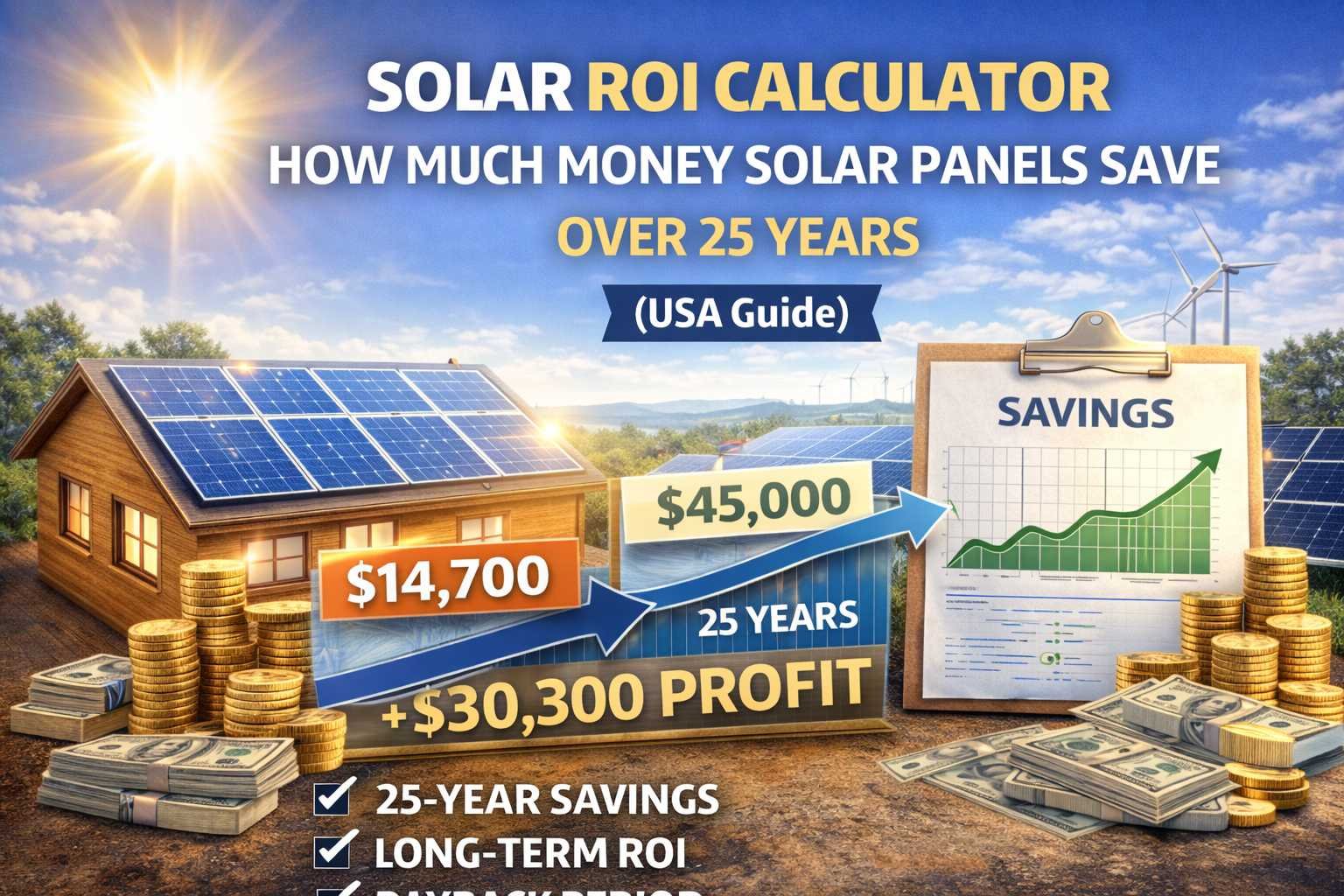
$21,000 − $6,300 = $14,700
This tax credit is one of the main reasons solar adoption continues to grow in the United States.
Solar ROI Calculator Formula
Homeowners can estimate solar ROI using a simple calculation.
Solar ROI = Total Energy Savings − Total System Cost
Example calculation:
Total electricity savings over 25 years: $45,000
Solar system cost after incentives: $14,700
Estimated profit:
$45,000 − $14,700 = $30,300
This example shows how solar panels can produce significant long-term savings.
Example Solar Savings Over 25 Years
Below is a typical scenario for a medium-size residential solar system.
Solar system size: 7 kW
Installation cost: $21,000
Federal tax credit: $6,300
Net system cost: $14,700
Average annual electricity savings: $1,600
25-year electricity savings:
$1,600 × 25 = $40,000
Estimated profit after system cost:
$40,000 − $14,700 = $25,300
This calculation shows how solar panels can deliver strong long-term financial returns.
Solar Payback Period
The solar payback period is the amount of time required for electricity savings to cover the installation cost.
In the United States, most solar systems have a payback period between 6 and 10 years depending on electricity prices and incentives.
After the payback period, homeowners effectively generate free electricity for the remaining lifespan of the system.
Factors That Affect Solar ROI
Several factors influence the total savings homeowners receive from solar energy.
Electricity Prices
Higher utility rates increase the value of solar electricity.
States with high electricity costs often deliver faster solar payback periods.
Sunlight and Location
Homes located in sunny states generate more electricity, increasing overall savings.
System Size
Larger solar systems produce more electricity and reduce more grid power usage.
Solar Incentives
Federal tax credits and state incentives significantly improve solar ROI.
Electricity Rate Inflation
Utility rates tend to increase over time. As electricity prices rise, solar savings become even larger.
States With the Highest Solar Savings
Solar ROI is often strongest in states with high electricity prices and strong solar incentives.
Examples include:
California
New York
Massachusetts
New Jersey
Arizona
Texas
Florida
In these states, homeowners often see faster solar payback and higher lifetime savings.
Additional Financial Benefits of Solar Panels
Solar energy offers several financial advantages beyond electricity savings.
Higher property value
Protection from rising energy prices
Reduced dependence on utilities
Potential state incentives and rebates
Long-term energy cost stability
Homes with solar panels often sell faster and at higher prices in many real estate markets.
Is Solar Worth It Over 25 Years?
For many homeowners in the United States, solar panels provide one of the best long-term financial returns available for home upgrades.
Over a 25-year period, many residential systems generate $20,000 to $50,000 in electricity savings depending on location and system size.
Because solar panels continue producing electricity long after the payback period, homeowners can benefit from decades of energy savings.
Final Thoughts
A Solar ROI Calculator helps homeowners estimate the long-term financial benefits of installing solar panels.
By factoring in installation cost, tax incentives, electricity savings, and system lifespan, homeowners can see the real value of switching to solar energy.
With federal incentives, declining installation costs, and rising electricity prices, solar panels remain one of the most profitable renewable energy investments for homeowners in the United States.